Repairs
Mobile Suspension & Steering Repair
Every clunk, wobble and pull is the car telling you a joint has play in it. Worn suspension does not just ride badly, it lengthens your stopping distance and eats tires.
Every clunk, wobble and pull is the car telling you a joint has play in it. Worn suspension does not just ride badly, it lengthens your stopping distance and eats tires.
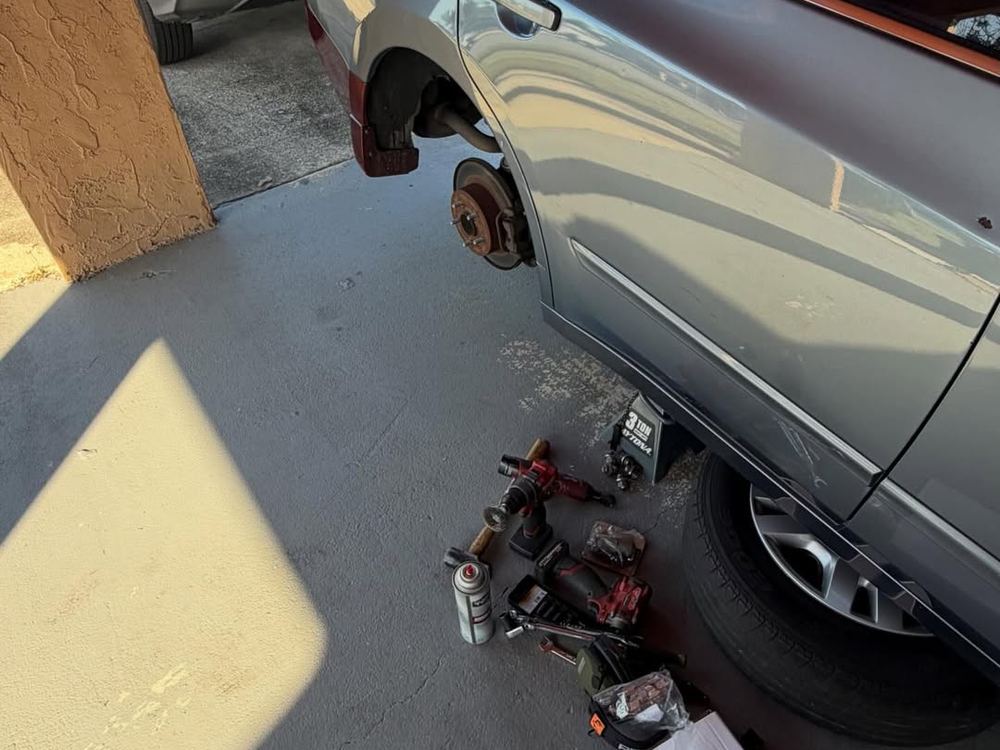
Suspension wear creeps up so gradually that most drivers adapt to it without noticing. Then they drive a friend's car and realise how much movement they had accepted as normal. Beyond comfort, worn suspension has real consequences: a shock that cannot control the wheel lets the tire skip across the surface, which lengthens braking distance and destroys tread.
Central Florida does not have potholes carved by freeze-thaw cycles, but it has plenty of construction-zone transitions, kerbs and speed tables, and heavy seasonal rain. That last one matters more than people think: worn shocks and struts dramatically increase the risk of hydroplaning, because the suspension can no longer keep the tire pressed into the water film. During our afternoon storm season, tired dampers are a genuine safety item, not a comfort complaint.
We do not replace parts because they are "probably" the noise. We safely lift the vehicle, check every joint for play by hand with a pry bar, inspect bushings for cracking and separation, look for shock oil weeping down the body, and road test where we need to. Then you get told which specific component is worn and what happens if you leave it. Worn suspension shows up in tire wear and often alongside brake work, so we check those while the wheels are off. Note that we do not perform wheel alignment on site, that requires an alignment rack, and we will tell you when you need one.
A great deal of it, yes. Shocks, struts, sway bar links, tie rod ends, control arms and wheel bearings are all realistic driveway jobs with the right equipment on a solid, level surface. We will tell you if a specific job genuinely needs a lift.
No, alignment needs a dedicated rack and we will not pretend otherwise. We will tell you when a repair requires an alignment afterward, which is typically any time we replace a tie rod or a control arm, so you can budget for it.
Commonly 50,000 to 100,000 miles. They degrade gradually, so the honest test is a bounce test and an inspection for weeping, not the odometer alone.
It depends entirely on what is clunking. A sway bar link is annoying. A ball joint with play in it can separate and drop the wheel, which is a genuine emergency. That is exactly why we identify the specific joint rather than guessing.
Very often. Cupped wear usually means worn dampers, inner or outer edge wear usually means alignment or a worn joint. The wear pattern tells us where to look.
Oil, brakes, batteries, AC, diagnostics and no-starts, done in your driveway across Orlando, Lake Nona, St. Cloud and Kissimmee. Upfront price before we start.